Denim is not like a basic T-shirt. A pair of jeans combines fabric, fit, wash, and hardware, and a small mistake in any of them can change the whole garment. Fabric shrinks differently after each wash recipe, and shade can shift between batches.
This guide walks through the six stages of a custom denim order, from design file to shipment. It is written for brand owners, online sellers, and sourcing teams who want to know what happens at each stage, what the factory needs from you, and where problems usually start.
A note on numbers: MOQs, lead times, costs, and tolerances in this article are typical ranges that vary by factory, fabric, and wash. Treat them as planning references, and always confirm exact terms in a written quotation.
The Process at a Glance
| Stage | What happens | Your key input |
|---|---|---|
| 1. Tech pack | Design is turned into production instructions | Flats, measurements, BOM, wash reference |
| 2. Fabric and trims | Fabric, thread, and hardware are selected | Weight, stretch, color, hardware spec |
| 3. Sampling and wash development | First sample and wash trials | Fit feedback, wash approval |
| 4. Pre-production (PP) sample | Final approval before bulk | Sign-off on the PP sample |
| 5. Bulk production | Cutting, sewing, washing, finishing | Timely decisions, agreed standards |
| 6. Final QC and shipping | Inspection, testing, packing | Inspection standard and shipping details |
Stage 1: Build a Production-Ready Tech Pack
A tech pack turns your idea into instructions a factory can follow. The more complete it is, the fewer rounds of sampling you will need.
A good denim tech pack includes:
- Flat sketches (front, back, and side): with stitch types, rivet positions, and details such as whiskers or rips marked clearly.
- Measurement spec (POM): your base size, usually 15 to 25 key measurements (waist, seat, front and back rise, thigh, knee, leg opening, inseam, and so on), each with a tolerance.
- Bill of materials (BOM): main fabric, pocketing, thread (main and topstitching), buttons, rivets, zipper, patches, and labels, with specs and colors.
- Wash reference: a physical swatch or clear photos from several angles. Describe the base color, contrast level, whiskers, and any tint.
- Label and branding placement: position and attachment method for the main label, care label, size label, and any flag or side-seam labels.
Tip: if you don't have a full tech pack yet, send a reference garment or sketches. A good factory can help you build one, but expect a longer development time.
Stage 2: Choose Fabric and Trims
In denim, the fabric and the wash define much of the final result. Think about five things.
1. Weight. Denim weight is usually quoted in ounces per square yard (1 oz/yd² is about 33.9 g/m²). Rough guides:
- Lightweight (about 4.5 to 9.5 oz): shirts, dresses, soft wide-leg styles
- Midweight (about 10 to 13.5 oz): the range where many everyday jeans and jackets sit
- Heavyweight (about 14 oz and up): workwear and rigid, heritage-style jeans
Weight is not quality. Always confirm the unit and whether the weight is measured before or after washing.
2. Stretch and composition.
- 100% cotton (rigid): clear fading, structured look
- Comfort stretch (for example, about 98% cotton with 2% elastane): keeps a cotton feel with more ease
- High stretch: common for skinny fits, with more polyester and elastane
- Dual-core or recovery yarns: designed to resist bagging at the knees
3. Yarn and weave. Ring-spun yarn tends to give more texture and richer fading; open-end yarn gives a flatter, more even look. Right-hand twill is the common choice, left-hand twill feels softer, and broken twill helps reduce leg twisting.
4. Selvedge or standard. Selvedge denim is woven on narrow shuttle looms, has a finished edge, and usually costs more and uses more fabric per pair than standard wide-width denim.
5. Color. Pure indigo, sulphur black, and overdyed shades each give a different fading character.
For trims, decide early on zipper type, button and rivet finish, patch material, and thread. Custom-molded hardware needs extra time for tooling.
Stage 3: Sampling and Wash Development
Sampling usually moves in steps:
- Proto or fit sample: made in a similar substitute fabric to check pattern, shape, and proportions.
- Wash trials: wash recipes are tested on panels or small pieces of your actual fabric to judge fade, contrast, and hand feel.
- Sales or corrected sample: made in the correct fabric with the proposed wash, used for evaluation or presentations.
Behind the scenes, two things matter a lot:
- Shrinkage allowance. Denim shrinks in length and width, and the amount depends on the fabric and the wash. Heavier washes generally shrink more than light ones. The pattern must be adjusted for each wash recipe, not just for the fabric.
- The wash ticket. The factory records the recipe: water temperature, chemicals, stone or enzyme dosage, drum time, laser settings, drying. A documented recipe is what makes repeat orders possible.
Stage 4: Pre-Production Sample and Size Set
The PP sample is the final checkpoint before bulk. It should be made with the actual bulk fabric, trims, thread, and approved wash.
Key steps:
- Test the bulk fabric. Shrinkage can vary between fabric lots, so wash-test the bulk fabric and confirm the result before cutting.
- Grade the sizes. Sizes are graded from the base size. It is wise to check the smallest and largest sizes as well, not only the base size.
- Sign off. Both you and the factory keep an approved PP sample. It becomes the reference for final inspection.
Don't skip or rush this step. Most disputes over bulk quality come from unclear approvals at this stage.
Stage 5: Bulk Production
Fabric spreading and cutting. Rolls are usually allowed to relax before spreading to release tension. Fabric is laid in layers and cut, often with computer-controlled cutters for accuracy.
Sewing. Denim uses specialized construction:
- Felled or lap seams on high-stress seams such as the outseam and back rise
- Bartacks at pocket corners, belt loops, and the base of the fly
- Chain-stitch hems, which can create the "roping" effect after washing
Bulk washing. Garments are processed in industrial machines in lots. Typical steps include desizing, enzyme or stone treatments, bleaching or tinting, rinsing, and drying. Dry processes such as hand-sanding or laser finishing work alongside the wet steps.
Finishing and hardware. Garments are dried, hardware is attached, patches are sewn on, threads are trimmed, and pieces are pressed.
What makes bulk run smoothly: quick decisions on your side, no spec changes after PP approval, and shade control (see below).
Stage 6: Final QC, Testing, and Shipping
Inspection. Many buyers use AQL sampling for final inspection. Agree in writing on the lot size, inspection level, defect classification (critical, major, minor), and accept/reject limits. Remember that an AQL value is a sampling rule, not a promise that a fixed percentage of the shipment is defective. Metal detection (needle detection) is also common, especially for export to the EU and the US.
Testing. Depending on your market and spec, tests may include:
- Dimensional change (shrinkage) after washing
- Colorfastness to crocking (rubbing)
- Seam strength
- Button and hardware pull strength
- Tear strength, especially for heavily washed styles
Use the test methods and pass levels required by your brand and your destination market (for example, ASTM, ISO, or AATCC methods), and put them in the purchase agreement. Children's wear and some markets have additional legal requirements.
Packing and shipping. Garments are tagged, barcoded, folded, and polybagged, then packed in export cartons with moisture protection and palletized or loaded for shipment.
Typical MOQ, Lead Time, and Cost Structure
MOQ (examples; varies by factory)
| Production mode | Typical situation | Rough MOQ range |
|---|---|---|
| Stock-fabric small order | Startups, test collections | Around 100 to 300 pcs per style |
| Standard bulk order | Established brands, core styles | Around 500 to 1,000 pcs per style |
| Custom-woven or custom-dyed fabric | Exclusive weight, yarn, or stretch | Set by the mill's minimum, often several thousand meters |
| Selvedge denim | Premium and heritage lines | Varies widely |
Washing also has a minimum load per batch, which often drives the practical MOQ. Always ask whether MOQ is counted per style, per color, or per wash.
Lead time (rough planning guide)
| Stage | Typical time |
|---|---|
| Tech pack review and pattern | 2 to 4 working days |
| First sample | 7 to 10 working days |
| Wash trials | 5 to 7 working days |
| PP sample and approval | 7 to 10 working days |
| Fabric and trims preparation | 15 to 25 working days (longer for custom-woven fabric or custom hardware) |
| Cutting, sewing, bulk wash | 20 to 30 working days |
| Final inspection, packing, loading | 4 to 6 working days |
For a first order, many buyers plan for about two months or more from tech pack to shipment. Repeat orders on approved styles are usually faster. Expedited schedules exist, but usually need stock fabric and quick approvals.
Where the money goes (rough illustration)
| Cost component | Approximate share of cost |
|---|---|
| Fabric | 40% to 50% |
| Washing and finishing | 15% to 25% |
| Cut and sew (labor) | 15% to 22% |
| Hardware, labels, packaging | 6% to 10% |
| Loss, QC, testing, margin | 8% to 12% |
Shares shift with fabric type and wash complexity. A heavy wash with laser and hand work can cost far more than a simple rinse wash, and selvedge fabric raises the fabric share.
Understanding Wash Techniques
| Wash type | What it does | Notes |
|---|---|---|
| Rinse (raw) wash | Removes sizing, keeps deep indigo | Soft feel, minimal fading |
| Stone wash | Pumice stones create natural wear at seams and edges | Classic vintage look |
| Enzyme wash | Cellulase softens and fades the surface | Often used with or in place of stones |
| Bleach / acid wash | Strong contrast and mottled effects | Needs careful control; can weaken fabric |
| Laser finishing | Digitally controlled fading, whiskers, and patterns | A dry process, consistent and repeatable; the full garment finish may still use water |
| Ozone finishing | Uses ozone for fading and bleaching effects | Can reduce water and chemical use compared with conventional bleaching, depending on the process |
If sustainability matters to your brand, ask what the factory actually does and what certifications it holds, and ask for documents rather than general claims.
Five Common Problems (and How to Prevent Them)
1. Shade variation between lots.
Different fabric lots and wash loads can produce different shades.
Prevention: separate fabric by lot and shade group before cutting, use approved light, standard, and dark reference limits for each wash, and compare bulk garments with the approved sample.
2. Leg twisting.
Twill fabric can release internal tension during washing, causing side seams to twist.
Prevention: choose well-finished, skew-controlled fabric, consider broken twill, make pattern adjustments where needed, and set a twist tolerance in the spec.
3. Over-washing and weak fabric.
Harsh bleaching or aggressive treatments can weaken fibers and cause tears at pockets or knees.
Prevention: set tear and strength requirements, and review heavy wash recipes for fabric damage.
4. Wrong sizing from shrinkage.
Different washes shrink differently.
Prevention: measure shrinkage per wash recipe, and base the pattern on that result rather than a general fabric figure.
5. Loose or rusting hardware.
Poor attachment or low-grade plating can lead to failures.
Prevention: specify hardware quality and pull-strength requirements, test at the start of each production run, and ask about corrosion testing for metal parts.
Example measurement tolerances (agree these with your factory for your own spec):
| Measurement | Typical tolerance |
|---|---|
| Waist | about ±1.0 cm |
| Seat | about ±1.2 cm |
| Front and back rise | about ±0.6 cm |
| Inseam | about ±1.2 cm |
| Thigh | about ±0.8 cm |
| Leg opening | about ±0.6 cm |
How to Choose a Denim OEM/ODM Partner
Before you commit, check these points:
- Process control: which steps are in-house, and which are outsourced?
- Development support: can the team help with tech packs, wash development, and pattern work?
- Clear terms: MOQ definition, sample cost, lead-time start point, and what's included in the quote.
- Documented quality system: written inspection standards, test reports, and wash records.
- Verification: willingness to arrange a factory visit or live video tour.
If you are also planning to visit the Canton Fair, our 5-minute supplier screening checklist shows what to look at and ask on the show floor.
Work With DYXM
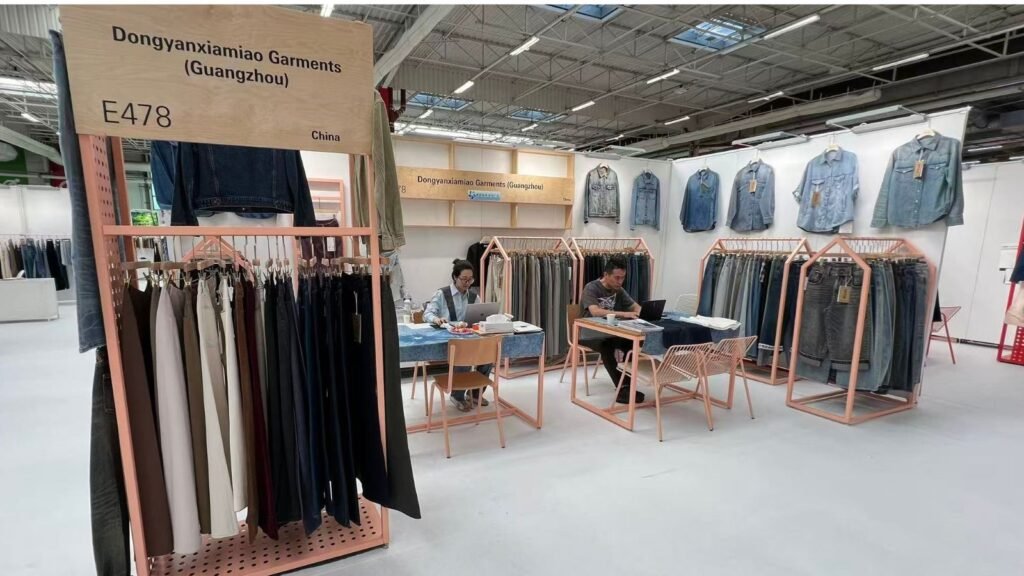
Guangzhou Dongyanxiamiao Garments Co., Ltd. (DYXM) is a denim and casualwear manufacturer based in Xintang, Guangzhou, the "Denim Capital of China." We combine design, production, and sales, with a 5,000 m² production base and more than 200 experienced employees in sewing, finishing, and washing. We export mainly to Russia, the EU, the USA, and the UK.
Ways we can work with you:
Browse our collections: Men's Jeans, Women's Jeans, Men's Jackets, Women's Jackets, Denim Shirts and Overshirts, and Other Denim Apparel.
Visiting the Canton Fair? Meet us at the 140th Canton Fair Phase 3, October 31 to November 4, 2026, Booth 1.1Y25-26, Canton Fair Complex, Pazhou, Guangzhou.
Ready to start a project? Contact us with your sketches, reference garment, or tech pack, plus your target market and estimated quantities. Learn more about DYXM.