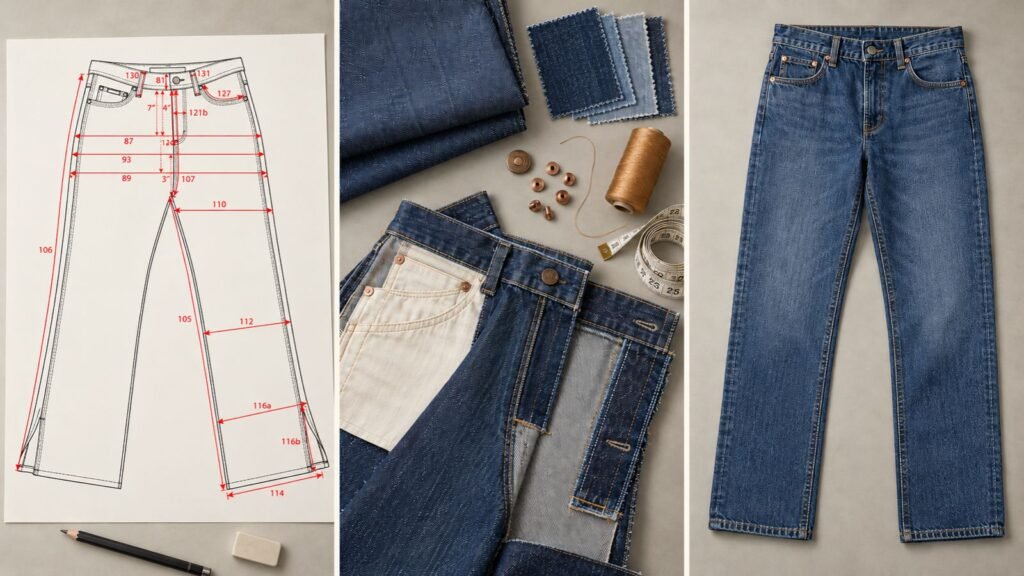
The 140th Canton Fair Phase 3 runs from October 31 to November 4, 2026, and there will be a lot of denim suppliers to see. Your time is limited, so a clear routine helps.
One thing up front: five minutes at a booth is a first screening, not a factory audit. It can tell you whether a supplier deserves a deeper look. It cannot guarantee bulk quality. Think of the booth visit as the start of the process, and plan to verify the rest after the show.
Below is the checklist we would use ourselves if we were buying.
The 5-Minute Screening Table
| What to check | What to do at the booth | What to ask | What it can't tell you | How to verify after the fair |
|---|---|---|---|---|
| Fabric | Touch the fabric, check swatch cards | "What is the weight in oz? Before or after washing? What is the stretch content?" | Hand feel cannot prove weight or composition | Request fabric weight and shrinkage test reports |
| Washing | Compare two or three pieces of the same style side by side | "How do you control shade variation in bulk? Is the distressing done by laser or by hand?" | Distressed effects are designed to vary, so look for consistency within a batch | Request wash samples and shade-control documentation |
| Stitching | Check stitch density (SPI), and with permission, gently pull stress points | "What reinforcement do you use? What SPI standard do you follow?" | A quick tug is not a seam strength test | In-line inspection and agreed-standard sampling |
| Hardware | Operate the zipper, check buttons and rivets, feel edges for burrs | "What zipper brand do you use? Will bulk hardware match the sample?" | A famous brand is a plus, not proof of quality | Hardware function tests during bulk inspection |
| Terms | N/A | "How is MOQ counted? How long does sampling take? When does lead time start?" | Booth quotes are only a starting point | Compare itemized written quotations |
| Supplier identity | Match booth number, business card, and company name | "Which processes do you do in-house, and which are outsourced?" | A different entity name is not automatically a problem, but it needs a clear explanation | Factory visit (on-site or live video), third-party audit |
Fabric: Ask About Weight, and Ask How It Was Measured
Denim weight is usually quoted in ounces per square yard (oz/yd²). As a rule of thumb, 1 oz/yd² ≈ 33.9 g/m², so 12 oz is roughly 407 g/m².
Common reference ranges (they vary between sources, so treat them as rough guides):
- About 10 oz: lighter fabric, often used for summer styles
- 11 to 13 oz: the range where many everyday jeans sit
- 14 oz and above: heavier, stiffer, rigid denim
Three things to keep in mind:
- Weight is not quality. Yarn count, weave, and composition all change how a fabric feels and performs, even at the same weight.
- Confirm the unit. Most suppliers quote per square yard, but a few quote per square meter. A "12 oz" figure on a per-square-meter basis is about 16% lighter in practice.
- Ask about the measurement state. Is the weight taken on raw fabric before washing, or on the finished, washed garment? Washing and finishing change the final weight.
Don't rely on touch alone. Ask for test data. Fabric weight can be tested to recognized methods such as ASTM D3776.
Washing: Look for Consistency Within a Batch
Common denim washes include:
- Stone wash: pumice stones tumble with the garment to remove surface indigo, giving a soft, vintage look
- Enzyme wash: cellulase enzymes soften the fabric and brighten the look, often as an alternative or complement to stone washing
- Laser finishing: increasingly used for whiskers and patterns instead of hand-sanding or chemical spraying
Two cautions:
- Wash names describe a finishing process, not the fabric's weight or composition.
- Laser finishing is a dry process, but that does not mean the whole garment finishing process uses zero water. Be wary of "laser = waterless denim" claims.
A practical test: ask to see two or three pieces of the same style side by side. Look at the shade. Then ask: "How do you control shade variation in bulk, and how do you group fabric into shade lots?" Good suppliers can explain how fabric is inspected for defects and sorted by shade before cutting, and how finished garments are checked against an approved sample after washing.
Keep in mind that hand-distressed or vintage looks are not meant to make every piece identical. Consistency means staying within an agreed standard.
Stitching: SPI and Reinforcement
SPI (stitches per inch) measures stitch density. A higher number is not always better. The right SPI depends on the fabric thickness, the seam construction, and your tech pack.
Look at the stress points: pocket corners, belt loops, crotch, and the inside of back pockets. Common reinforcement methods include bartacks, rivets, and double-needle stitching. The question isn't whether every area uses the same method, but whether the specified reinforcement is complete and properly done.
A quick checklist of common stitching defects:
- Skipped stitches
- Broken threads
- Uneven stitching
- Puckered seams
- Open seams
- Missing or weak bartacks
With the exhibitor's permission, you can lightly pull stress areas and turn out the back pocket to check the reinforcement. Just remember this is a visual check, not a substitute for lab seam strength testing.
Hardware: Test It With Your Hands
- Zip the zipper up and down several times
- Check whether buttons and rivets are tight
- Run a finger along edges to feel for burrs
Branded hardware (such as YKK) is a good sign, but a brand name is not a quality guarantee. Ask whether the bulk hardware will match the sample, and put it in the contract. Pull-strength and other function tests happen after the fair, according to the standards you agree on.
Terms: Ask About the Definitions, Not Just the Numbers
MOQs, sampling times, and lead times vary a lot from factory to factory. Numbers you find online are examples from individual suppliers, not industry standards. What matters more is how each term is defined.
MOQ questions to ask:
- Is MOQ counted per style, per color, per wash, or per fabric?
- If I order two colors of the same style, can the quantities be combined?
- Can different styles in the same fabric be counted together?
Sampling and lead time:
- How long does sampling take, and what does it cost?
- Is the sample fee credited against a bulk order?
- Does lead time start from the signed pre-production sample, or from the deposit?
Quotation:
- What's included: trims, labels, testing, packaging, inspection?
Remember that a booth quote is a starting point. Real pricing comes from a formal RFQ with full specifications after the show.
Supplier Identity: Ask "Who Makes It, and Who Is Responsible?"
Being a trading company doesn't make a supplier unreliable. The point is that you have the right to know who you're working with. Useful questions:
- Which processes (cutting, sewing, washing, embroidery) are in-house, and which are outsourced? Who is responsible for quality on the outsourced parts?
- Are the contracting entity, the exporting entity, and the producing entity the same company?
- Are the samples on display made by this factory or by a partner?
At the fair, you can compare the booth number, the business card, and the exhibitor name in the official directory. If something doesn't match, simply ask. Different names or addresses can have normal explanations (an export company, an affiliated factory, a separate site), but a good supplier can explain them clearly. You can also check registration details through China's official enterprise credit system (gsxt.gov.cn), keeping in mind that a business scope shows what a company is registered to do, not its actual capacity.
Finally, ask whether they can arrange a factory visit or a live video tour of the production line after the show. Willingness to do this is a positive sign.
Certifications: Know What Each One Actually Proves
When a supplier shows you a certificate, ask three things: who and what does it cover, does it include the product category I want to buy, and is it currently valid? You can often verify directly with the issuing body.
| Certification / audit | What it is | What it covers | What it does not prove |
|---|---|---|---|
| OEKO-TEX STANDARD 100 | Product testing label for harmful substances | Listed products and their components (thread, buttons, etc.) tested against a long list of harmful substances | Factory operations, fiber origin, or worker conditions. It covers listed products only, not everything a factory makes |
| GRS (Global Recycled Standard) | Third-party standard for recycled content | Recycled content, chain-of-custody tracing, and social, environmental, and chemical requirements in processing | Product quality or legal compliance. A scope certificate shows a company is eligible to produce certified goods; a transaction certificate is what verifies a specific shipment |
| amfori BSCI | A social compliance audit and rating system, not a certification | Working conditions across performance areas such as working hours, wages, and health and safety | Product quality. Ask which site was audited, when, the rating, and the status of corrective actions |
| ISO 9001 | Quality management system certification | That the organization has a management system to control its processes | That any specific product passed a particular test, or that defects are zero |
After the Fair: Verify What You Couldn't See
Here is what to do once you're back at your desk:
- Follow up within 48 hours with a formal RFQ and complete specifications.
- Request test reports, including fabric weight, dimensional change (shrinkage) after washing under agreed conditions, colorfastness, and seam strength where relevant.
- Agree on inspection standards in writing. If you use AQL sampling, specify the lot size, inspection level, defect classification, and accept/reject criteria.
- Arrange a factory visit or third-party audit before placing a large order.
A common AQL misunderstanding: AQL 2.5 does not mean 2.5% of the whole shipment is allowed to be defective. It is a sampling-plan decision rule. For example, for a 4,000-piece order at General Inspection Level II and AQL 2.5, you would inspect 200 pieces. If there are 10 or fewer defective pieces, the lot passes; with 11 or more, it is rejected.
Questions to Take to the Booth
- Which processes (cutting, sewing, washing, embroidery) do you do in-house, and which do you outsource? Who is responsible for quality on outsourced work?
- Is MOQ counted by style, color, or wash? Can styles in the same fabric be combined?
- How long does sampling take, and what does it cost? Is the fee credited against bulk orders?
- When does the lead time start: after pre-production sample approval, or after